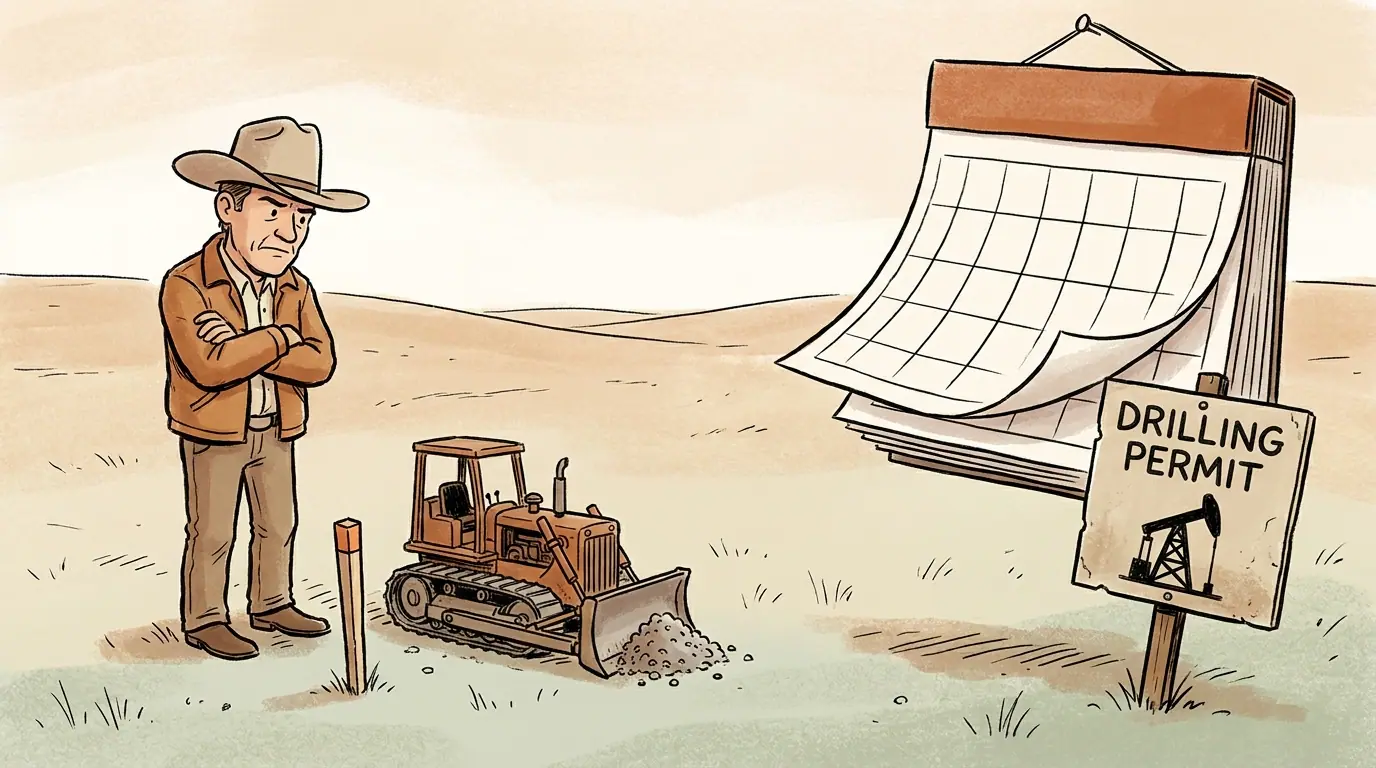
A mineral owner signs a three-year oil and gas lease. For thirty-five months, nothing happens. Grass grows over old pasture roads, the operator ignores phone calls, and no drilling rig appears on the horizon. With sixty days left, landmen begin contacting the family to inquire about leasing the tract once the current term expires. Bonus numbers in the area have jumped since the original deal was struck, perhaps moving from $500 an acre to $2,500 an acre. The family calculates the potential new bonus, files the old paperwork, and prepares to sign a new contract the day after the calendar turns.
Then, forty-eight hours before midnight of the final day, a contractor unloads a bulldozer on the property. A maintainer scrapes a flat spot in the pasture, a truck dumps two loads of caliche gravel near the gate, and a wooden stake appears in the ground with surveyor ribbon tied to the top. The operator has an approved drilling permit from the regulatory agency.
The mineral owner calls the operator to state that the lease is expiring. The operator replies that operations have commenced, the lease is locked into its secondary term, and no new bonus will be paid.
This scenario plays out across Texas basins every year. Mineral owners often view this last-minute activity as a bad-faith bluff, assuming that drilling requires an actual rig boring into the earth. The law, however, treats the question with far more nuance, and in many jurisdictions, that load of gravel is enough to keep the agreement alive.
- Primary term expiration approaches
- Generic commencement clause
- Road grading and gravel deliveryLease held if pursued with bona fide diligence
- Strict spud-in clause
- No drilling bit in the groundLease terminates at midnight
How lease wording dictates whether preliminary surface work holds a lease past the primary term.
The habendum clause and the mechanics of lease expiration
To understand how minimal physical activity can preserve a contract, an owner must review the basic anatomy of an oil and gas lease.
A standard lease creates a fee simple determinable estate in the mineral interest, as the Texas Supreme Court reaffirmed in cases like Anadarko Petroleum Corp. v. Thompson. Under this structure, the mineral estate automatically reverts to the lessor upon the occurrence of certain conditions. The duration of the grant is governed by the :habendum clause, which divides the lease into two distinct eras: the :primary term and the secondary term.
The primary term is a set window of time, commonly three or five years, during which the lessee has the option, but generally not the legal duty, to develop the property. The secondary term continues “as long thereafter as oil or gas is produced in paying quantities,” or so long as other specific lease savings clauses are satisfied.
If the operator achieves production in paying quantities before the primary term ends, the lease automatically transitions into the secondary term. But when no oil or gas has been discovered by the final week of the term, operators rely on savings clauses known as “commencement of operations” or “continuous drilling” provisions.
These clauses state that if the lessee commences drilling operations before the expiration date, the lease remains in effect for as long as those operations are prosecuted with reasonable diligence. If commercial production results, the lease transitions into the secondary term just as if the well had been completed years earlier.
The legal question then shifts away from production and focuses entirely on what the word “commence” means.
What constitutes commencement under standard legal standards
Mineral owners often assume that “commencing drilling” means turning a drill bit into the rock. In the courtroom, that assumption usually fails unless the lease contains explicit protective wording.
In most producing states, actual drilling is unnecessary to satisfy a generic commencement provision. Legal research published by Holland & Hart LLP shows that in the majority of jurisdictions, courts apply a two-prong test. An operator commences operations when:
- The lessee performs preliminary acts on or near the premises that are directly preparatory to drilling.
- The acts are conducted with the bona fide, good-faith intention to proceed with diligence toward completing the well.
Under this majority standard, courts have held that staking a location, clearing timber, leveling a pad, digging a slush pit, hauling caliche onto an access road, or bringing pipe to the tract can satisfy the requirement. In North Dakota, for example, the federal court in Anderson v. Hess Corp. concluded that an operator had commenced operations where it surveyed and staked the well, secured a permit, built the well pad, widened an access road, and drilled mouse and rat holes, even though the main drilling rig was not yet on site. A similar approach has been followed in Wyoming cases such as Fast v. Whitney.
There are exceptions across state lines. In Montana, as noted in Solberg v. Sunburst Oil & Gas Co., courts drew a strict distinction between generic operations and commencing drilling operations, interpreting the latter to require :spud-in, meaning the first penetration of the ground by the drill bit. In Kansas, courts in cases like Hall v. JFW Inc. ruled that a lease requiring the operator to commence to drill had expired where preliminary site work had taken place but no drilling rig was on site before the deadline.
In Texas, however, the courts have long taken a practical view favoring the operator when lease language is loose. If an operator has secured an approved drilling permit from the Railroad Commission of Texas, contracted with a dirt crew to grade the pad, and started moving materials to the location before the clock strikes midnight, Texas courts will often find that operations commenced, provided the operator follows up by bringing in a rig and drilling without unreasonable pauses.
- Required activitySite prep, staking, or road gradingBit penetrating the ground
- Equipment requirementBulldozer or gravel truckRig capable of drilling to total depth
- Permit statusApplication filed or pendingFinal permit approved and posted
- Diligent progressionBroad, subjective reasonable intentStrict calendar day windows (e.g. 60 days)
A comparison of standard producer lease terms against negotiated mineral owner addenda.
The role of custom lease addenda
The outcome of an eleventh-hour dirt work dispute almost always traces back to the specific phrases chosen years earlier when the lease was executed. Standard producer forms, such as an unaltered Producers 88, are written by and for exploration companies. These forms use broad language, referencing “operations for drilling” or “drilling or reworking operations” without defining the terms.
Sophisticated mineral owners and oil and gas attorneys push back against standard language by attaching an addendum. In that addendum, the parties can define commencement with exact precision.
A protective addendum might state:
“Notwithstanding anything to the contrary contained herein, drilling operations shall not be deemed commenced under this lease unless and until an actual drilling rig capable of drilling to the permitted total depth of the well is rigged up on the leased premises, and the drill bit has penetrated the earth.”
When that sentence exists in the contract, a truck dumping caliche forty-eight hours before lease expiration has zero legal effect. If the rotary bit is not turning in the dirt by midnight on the final day, the lease terminates automatically. The property reverts, and the owner is free to negotiate with competing companies.
Without that custom language, the mineral owner faces an uphill evidentiary battle. Proving that an operator lacked “bona fide intent” requires hiring counsel, gathering testimony, subpeonaing rig contracts, and reviewing scheduling files to demonstrate that the operator staged the bulldozer solely to freeze the asset while shopping it to third parties. That litigation can drag on for months or years, during which title is clouded and no other company will touch the tract.
Continuous development and retained acreage issues
Commencement battles do not end once a well is drilled. Modern horizontal drilling programs regularly tie up thousands of acres across multiple sections. An operator may commence a single well at the end of the primary term to lock in a massive block of acreage, relying on a continuous development clause to keep the entire lease intact.
In Texas, these continuous development programs have produced extensive litigation. An operator typically must continue drilling successive wells within a set timeframe, often 120 or 150 days between the completion of one well and the commencement of the next. If the operator fails to maintain that schedule, the lease terminates as to all undeveloped acreage.
The mechanics of these clauses were addressed directly by the Texas Supreme Court in Endeavor Energy Resources, L.P. v. Energen Resources Corp.. That dispute centered on an 11,300-acre lease in Howard County. The lease allowed Endeavor to maintain its interest by drilling a new well every 150 days, with a provision allowing the company to “accumulate unused days in any 150-day term” to extend the subsequent deadline.
After Endeavor let 310 days pass without starting a thirteenth well, the mineral owner, Quinn, re-leased the unproven acreage to Energen, who promptly sued. Energen argued that unused days could only be carried forward once to the immediately following 150-day window. Endeavor argued it could bank unused days across multiple terms, giving it 377 days of credit. The Texas Supreme Court found the provision ambiguous, ruling in Endeavor’s favor on the title dispute because a special limitation that automatically terminates an estate must be clear and precise.
As analyzed in DGC Law’s review of retained-acreage clauses, retained-acreage language dictates when the clause is triggered, which interests are retained, and how many acres are severed from the lease. We examined how these mechanics function under Texas law in our guide on Texas Retained-Acreage Clauses: How One Well Can Hold a Lease. When drafting is vague, an operator can hold thousands of acres of deep rights or non-producing formations with minimal capital outlay, preventing the mineral owner from realizing the full market potential of their asset.
The danger of signing top leases in contested situations
When an owner sees an operator grading dirt at midnight, their instinct is often to notify other active landmen in the area that the lease is expiring. Some landmen will offer a :top lease.
A top lease is an oil and gas lease granted on mineral rights that are already subject to an existing, valid lease. If the existing bottom lease expires or terminates, the top lease becomes effective.
While top leasing can secure a new bonus in advance, doing so while an operator is conducting surface operations carries severe risks. If the bottom lessee asserts that its operations held the tract, the mineral owner can get dragged into title litigation between two well-funded energy companies. If the court determines that the bottom lease was held by preliminary dirt work, the top lessee may demand their bonus back, or worse, the original operator may sue for breach of contract or clouding of title.
Before signing competing agreements, the owner must know where they stand legally. We documented the expensive mechanics of these disputes in The Top Lease Crossfire: How Firing Your Operator Can Trigger a Texas Title Lawsuit. Walking into a lease fight without a definitive review of the underlying lease language rarely ends well for an individual owner.
Evaluating the true trade: holding versus selling
A midnight commencement dispute exposes a fundamental truth about mineral ownership: holding minerals is not an entirely passive, risk-free enterprise. It carries continuous administrative friction, timing risk, legal exposure, and market volatility.
When an operator stakes a pad at the last minute, the owner faces a set of uncertain paths:
- The operator may drill a token vertical well that generates $150 a month, holding hundreds of acres for twenty years while never drilling the lucrative horizontal targets.
- The operator may spud the well, run out of capital, leave the location idle, and force the family into expensive litigation to clear title.
- The operator may successfully complete a multi-well pad, resulting in strong royalty payments, but production will peak early and experience steep decline curves over the first two to three years.
Many owners instinctively approach this through a rigid binary lens: keeping the minerals means holding every ounce of future upside, while selling means giving up family heritage.
That perspective overlooks the actual financial trade.
Holding minerals means retaining future upside while accepting full commodity price swings, operator drilling schedules, depletion decline, and the potential that acreage sits undeveloped for decades. Selling, on the other hand, converts that uncertain future potential into known, liquid capital today.
Consider the arithmetic of an unleased or recently commenced tract. Suppose an owner holds 40 net mineral acres. A new lease bonus might pay $2,000 an acre, or $80,000 upfront. If the operator holds the acreage through a generic commencement clause and drills a modest well, the owner might receive $8,000 to $12,000 annually in royalties as the well declines.
Conversely, an active buyer might value those same 40 acres at $15,000 per acre based on surrounding horizontal activity, representing a purchase price of $600,000.
That $600,000 represents fifty to seventy-five years of expected royalty checks from a low-rate well, paid in cash today. It removes the risk of an operator drilling a dry hole, shutting in production, or going bankrupt during a market crash. That capital can be redeployed into diversified real estate, used to eliminate family debt, or passed down to heirs without the title fractures that happen when mineral rights are divided among multiple generations.
Owners do not need to make an all-or-nothing choice either. As we outlined in Should I Sell All or Just Part of My Mineral Rights?, selling a partial interest allows an owner to de-risk. An owner can sell twenty acres to secure liquidity and pay off a mortgage while keeping twenty acres to ride the upside of future drilling.
Moving from uncertainty to a clear valuation
When an operator dumps caliche on your property two days before a lease runs out, you cannot determine your best move by reading public forums or generic articles. County-wide estimates do not account for your property’s specific legal description, the exact wording of your commencement clause, the status of nearby offset permits, or the commercial track record of your operator.
Two owners in the same county can receive radically different offers for completely sound reasons. One tract may have a custom addendum that forces immediate lease forfeiture, opening the door to fresh bonus capital. Another tract across the county line may be locked down under an old form lease with a generic continuous development clause, preventing new leasing for the next decade.
Understanding what a knowledgeable buyer is willing to pay today gives you a baseline. A real offer provides clarity. You might look at a firm cash proposal and realize that the capital offered upfront exceeds what your family would collect in royalties over the next twenty years under the current operator’s drilling pace. Or you might see the number and decide that keeping the minerals and accepting the operational delays is worth the gamble.
Either choice is entirely valid. The distinction is that you make the decision with hard financial data rather than guessing what a midnight bulldozer means for your estate.
Double Fraction Minerals evaluates these situations daily. As a Texas family office, we review title chains, parse lease addenda, analyze operator regulatory filings, and study drilling activity across the Permian and wider Texas basins. We provide mineral owners with transparent, reliable valuations grounded in actual asset engineering and title law. If you are dealing with an expiring lease, a contested continuous development clause, or an operator attempting to hold your acreage with eleventh-hour dirt work, reviewing an offer gives you the information required to decide your next step on your own terms.
:habendum-clause
The provision in an oil and gas lease that sets the duration of the agreement, typically dividing it into a fixed primary term and an open-ended secondary term held by commercial production or continuous operations.
:primary-term
The initial period specified in an oil and gas lease, usually three to five years, during which the lessee must either establish production or conduct specified operations to prevent the lease from expiring.
:spud-in
The formal point in drilling operations when a drilling rig’s main rotary bit first penetrates the ground, distinct from preliminary surface preparations like leveling roads or digging mud pits.
:top-lease
A second oil and gas lease granted on a mineral property that is already burdened by an existing, active lease, structured to take effect automatically if and when the prior lease terminates.