
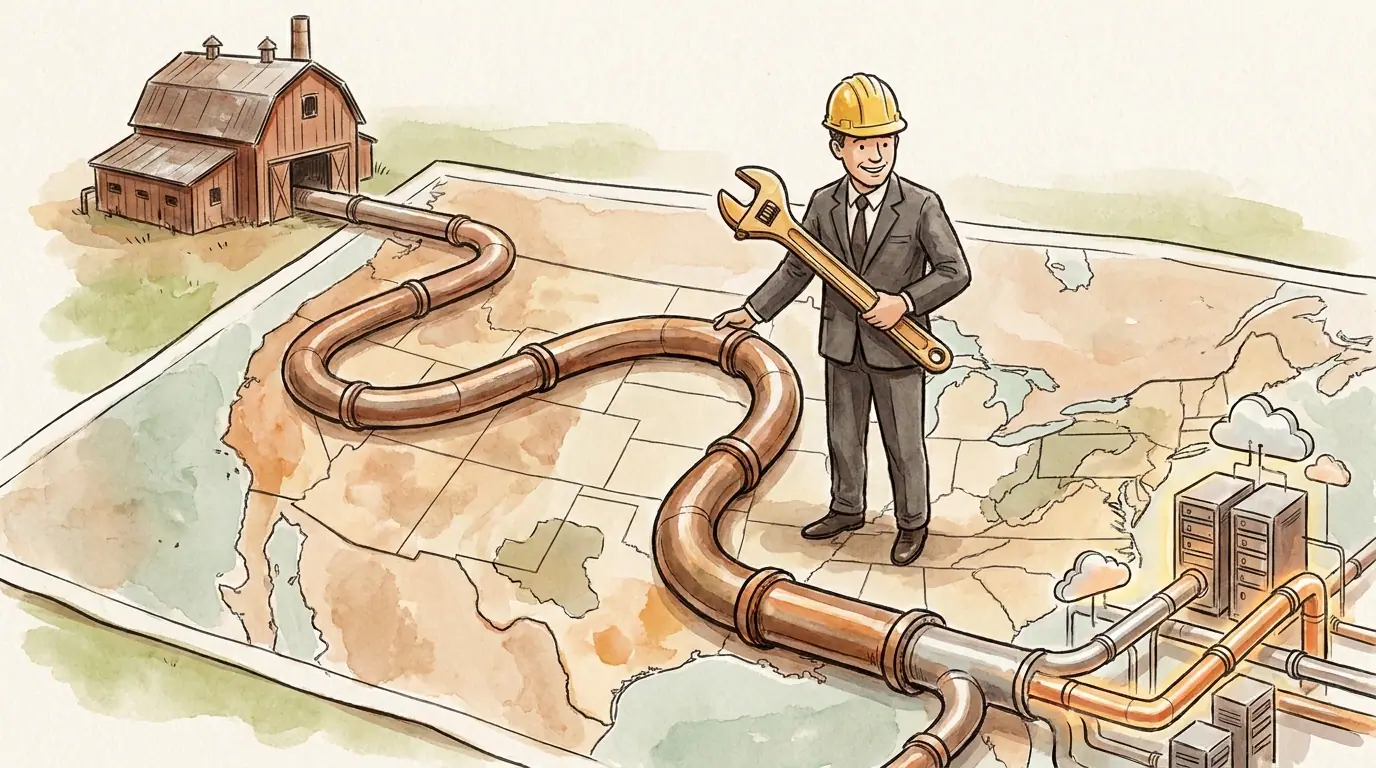
Marathon Petroleum Corporation and its midstream partnership, MPLX LP, agreed on November 3, 2026, to sell two Midcontinent refineries to CVR Energy for $4.2 billion. The deal hands Marathon $3.45 billion for refining and marketing assets while sending $750 million to MPLX, cash that chief executive officer Maryann Mannen stated will be redeployed to the Gulf Coast and into midstream expansions across the Permian and Marcellus basins.
- Combined post-deal capacity384,000 b/d
- Prior standalone capacity207,000 b/d
Crude processing capacity in barrels per day before and after acquiring Marathon Petroleum Midcontinent assets.
This capital flight from legacy downstream processing toward wellhead systems is not an isolated corporate transaction. Across the producing basins, corporate operators and financial institutions are concentrating their capital on upstream networks: field pipelines, gas gathering lines, and water distribution systems. As downstream assets change hands, the infrastructure that connects your producing wells to end users is undergoing consolidation.
For mineral and royalty owners, these infrastructure moves dictate the bottom line of every monthly check. The price you receive rarely equals the benchmark price quoted on the financial news. Instead, the net check you deposit reflects how efficiently your operator moves volumes, what local pipeline tolls they pay, and whether they deduct the processing and transport fees from your decimal interest. When multi-billion-dollar midstream footprints shift, the mechanics of those royalty deductions shift with them.
Capital leaves legacy processing to fund core basin gathering
When Marathon divested its 105,000 barrel per day St. Paul Park refinery in Minnesota and its 72,000 barrel per day Mandan refinery in North Dakota to CVR Energy in a $4.2-billion agreement, it chose to walk away from assets that generated over $1.1 billion of EBITDA in the first nine months of 2026. The refining sector carried high utilization rates, averaging 98 percent from 2023 through 2025. Yet Marathon and MPLX decided that those steady operational cash flows were better spent funding pipeline, gathering, and processing expansions in the Marcellus and Permian.
This transition illustrates how midstream economics are being reorganized. Downstream merchant refining carries volatile regulatory burdens, including the cost of Renewable Identification Numbers (RINs). Gathering systems, water handling pipelines, and regional takeaway lines generate predictable fee-based returns. When midstream operators build or purchase these upstream gathering backbones, they secure long-term utility-like margins paid directly out of the hydrocarbon stream.
A parallel transaction closed in the Williston basin on November 9, 2026. Bayou Midstream II acquired Argent Gas Solutions from Silver Hill Energy Partners. The transaction transferred 85 miles of natural gas pipelines, associated compression stations, and more than 60 million standard cubic feet per day of processing capacity located in North Dakota across Williams, Burke, and Mountrail counties. The footprint covers 140,000 dedicated gross surface acres.
When private equity entities like Silver Hill exit natural gas infrastructure to focus elsewhere, specialized midstream operators take control and seek to maximize throughput per pipeline mile. If your minerals sit inside a 140,000-acre dedication, the new system owner controls the gate between the casinghead and the sales point. Depending on the state where your wells produce and the language of your underlying lease, the expenses incurred to operate those 85 miles of pipe often flow straight to your check stub.
In North Dakota, mineral owners frequently contend with aggressive post-production cost accounting. Operators move raw casinghead gas across miles of local pipe, run it through processing plants, and strip out the liquids before handing the mineral owner a statement reduced by every step of the journey. When you examine your check stub, understanding how post-production costs shrink royalty checks is essential to catching unauthorized tariff jumps that occur when gathering networks trade hands between operators.
How localized power demand changes gas pricing at the meter
Capital is moving into Appalachian natural gas systems because local demand is decoupling from historical export patterns. For years, drillers in Pennsylvania, West Virginia, and Ohio faced severe pipeline bottlenecks. Operators had to pay steep transport tolls to push gas southeast to the Gulf Coast or east toward major metropolitan centers, causing local wellhead prices to trade at a deep discount to the national Henry Hub benchmark.
That dynamic is encountering a new physical demand source: on-system industrial power generation and data facilities. A review of the Pennsylvania Department of Environmental Protection permit filings by Marcellus Drilling News identified 27 data center projects currently seeking state environmental permits.
- Grid electric connection20 projects
- Dedicated on-site natural gas generation7 projects
Data center project applications filed with the Pennsylvania Department of Environmental Protection.
Seven of those 27 projects intend to bypass the traditional electric transmission grid entirely, burning natural gas directly on site or through dedicated, gas-fired power stations built on the premises. The remaining 20 intend to take power from a regional grid that relies heavily on natural gas-fired generation.
When an industrial consumer builds a power plant directly behind the meter in a producing basin, the structural :basis differential narrows. Gas does not have to travel 600 miles through interstate pipelines to reach a buyer. Instead, it enters localized gathering systems to supply regional turbines.
Drillers with established takeaway positions are already posting major operational gains from this local market transformation. Infinity Natural Resources (INR), a Morgantown-based operator focused entirely on the Marcellus and Utica formations, reported third-quarter production of 431.7 MMcfe/d. That volume represents a 100 percent increase over its output from the third quarter of 2025 and a 23.9 percent sequential jump over the second quarter of 2026.
INR achieved these numbers while completing its first deep dry gas Utica well in southwestern Pennsylvania. The driller attributed part of its realized revenue strength to legacy capacity on the Rockies Express Pipeline (REX) that it acquired from Antero, allowing it to move gas past congested local hubs to higher-priced markets while shopping for more leasehold across Pennsylvania, Ohio, and West Virginia.
If your minerals are situated in the Appalachian basin, local demand changes what an operator can charge you for shipping. Many legacy leases signed during the initial Marcellus leasing boom contained vague deductions language. When gas is consumed inside the basin or sold at nearby facility gates, operators should not be charging owners for phantom transport to distant sales hubs. Even so, many producers continue to deduct uniform transportation fees across their entire production base.
Reviewing your statements against Pennsylvania guaranteed minimum royalty rules reveals whether your payor is using midstream fees to quietly push your effective rate below statutory baselines.
Permian produced water and the industrial buildout
In Texas, the reallocation of infrastructure capital extends beyond hydrocarbons into fluid management. On November 10, 2026, Diamondback Energy and KKR agreed to purchase Five Point Infrastructure’s 70 percent equity interest in Deep Blue Midland Basin LLC. Diamondback already held a 30 percent stake; the deal leaves Diamondback and KKR as joint 100 percent owners of the largest independent water infrastructure system in the Midland basin.
The Deep Blue system handles massive scale: it moves, recycles, and disposes of nearly 2 million barrels of water per day across West Texas. Kaes Van’t Hof, chief executive officer of Diamondback, noted that the asset provides operational support for core drilling while positioning the partnership for industrial applications outside oil and gas, including cooling water for data center developments in the Permian.
For a mineral owner in West Texas, produced water was historically treated strictly as a lease operating expense, a cost incurred to dispose of an unwanted byproduct. In unconventional horizontal shale wells, an operator may produce three to six barrels of salty, mineralized water for every single barrel of crude oil brought to the surface.
Handling 2 million barrels of fluid daily requires gathering pipelines, commercial disposal wells, and recycling plants. When major upstream operators buy out their private equity partners to own the midstream water network, the corporate parent can charge its joint-interest partners and royalty owners high fees for water handling, turning a lease burden into an internal profit center.
In Texas, lease language controls what can be deducted. While water disposal fees incurred at the wellhead are generally legitimate lease operating expenses borne by the working interest, midstream gathering fees and transportation off the lease can become contentious. In some check statements, operators label water management under broad line items like “gathering,” “handling,” or “treating.”
Texas operators have also attempted to pass midstream commercial obligations onto royalty owners under opaque accounting categories. As companies construct integrated pipeline backbones for water and hydrocarbons, owners must confirm that operators are not using check stubs to fund transport overhead. Reviewing how operators deduct pipeline deficiency fees provides a direct look at the creative accounting mechanisms payors use to offload their infrastructure commitments onto royalty owners.
What mineral owners should audit on upcoming check stubs
When corporate midstream acquisitions close, the payor on your check or the accounting methodology on your monthly statement often changes within ninety days. You should pull your last three statements and check four specific areas.
First, check the payor name and remit-to address. When assets transfer, such as the 140,000 dedicated acres moving to Bayou Midstream II in the Bakken, or when water systems consolidate under entities like Deep Blue, division orders or corporate accounting departments update their systems. Confirm that the operator has your correct taxpayer identification number and address so your funds are not placed into statutory suspense.
Second, audit the gross realized sales price. Compare the price per thousand cubic feet (Mcf) of natural gas or per barrel (bbl) of oil on your check against the published monthly index for your region. In Pennsylvania and West Virginia, note whether your realized natural gas price improves if local drillers are contracting directly with regional industrial buyers or data facilities. If Henry Hub settles at $3.25 per Mcf, but your statement lists a gross price of $2.20 before deductions, your operator is absorbing a $1.05 basis haircut. Find out why that gas is being sold at such a wide discount when regional demand is expanding.
Third, look at the :post-production deductions column. Check stubs separate costs into several categories:
Common check stub deduction categories:
- Gathering and Compression: Fee paid to move raw gas through low-pressure lines to a central station.
- Transportation: Fee paid to ship gas through high-pressure transmission lines to a market hub.
- Processing / Fractionation: Cost to extract natural gas liquids (NGLs) from the dry methane stream.
- Water Handling / Disposal: Cost to transport and inject produced formation water.
If your lease contains an express “no-deductions” clause, the operator should not be assessing :gathering and compression costs against your share of production. Following a midstream buyout, buyers often apply standardized deduction formulas across all leases in the acquired unit, ignoring customized lease riders negotiated years earlier. If deductions suddenly appear on your check or increase on a per-unit basis, contact the payor in writing to request an itemized accounting breakdown.
Fourth, verify your division of interest decimal. When operators acquire new gathering systems or drill longer infill laterals, units are occasionally pooled, consolidated, or re-formed. A newly completed well, like the deep dry gas Utica wells being developed in southwestern Pennsylvania, can trigger unit revisions. Ensure that your decimal interest has not been diluted without an amended :division order detailing the exact acreage allocation.
What these infrastructure moves do not change for your title
While multi-billion-dollar deals generate significant market headlines, mineral owners must distinguish between midstream corporate realignments and upstream real property ownership.
These midstream buyouts do not change who owns the minerals under the ground. Marathon selling refineries to CVR Energy, or Diamondback acquiring equity in Deep Blue, involves commercial equipment, surface rights-of-way, and operational contracts. It does not alter your underlying deed, your severed mineral estate, or your executive leasing rights.
These transactions do not alter the contractual terms of your existing lease. A pipeline operator or an exploration company cannot unilaterally amend a signed oil and gas lease because they sold assets to another corporate entity. If your lease prohibits the deduction of post-production costs, the buyer of the gathering system must honor that prohibition. A midstream consolidation is not a legal license to rewrite lease covenants.
These transactions do not guarantee that new drilling will begin immediately on your tract. When a driller like Infinity Natural Resources doubles its production or secures pipeline space, it prioritizes drilling on the leases with the nearest expiration dates or the highest net revenue interests. An infrastructure buildout in your county means takeaway capacity is accessible, but it does not place a drilling rig on your property tomorrow.
Finally, these asset sales do not mean oil and gas prices will move in a straight line. Benchmark prices remain subject to broader economic variables, seasonal weather, storage levels, and global export capacity. Infrastructure improvements help protect against regional discounts, but they do not eliminate commodity risk.
If you are evaluating your monthly royalty income, auditing check stub deductions, or considering an offer to sell your mineral rights to diversify your holdings, Double Fraction Minerals offers clear, no-obligation assessments based on actual basin data. You can request a straightforward review of your property to understand the true market value of your interest through our mineral rights valuation team.
:basis-differential
The pricing difference between a local regional trading hub or wellhead delivery point and a national benchmark hub, such as Henry Hub for natural gas or Cushing for crude oil. This difference reflects local pipeline capacity, transportation tariffs, and regional supply and demand conditions.
:gathering-and-compression
The midstream process of collecting raw oil, natural gas, and water from individual wellheads through a network of small-diameter, low-pressure pipelines, and running it through compressors to increase the pressure so the hydrocarbons can enter larger transmission pipelines or processing plants.
:post-production-deductions
Costs incurred by the working interest operator after hydrocarbons leave the wellhead to make the product marketable or transport it to a commercial sales point. These expenses can include gathering, dehydrating, compressing, processing, treating, and pipeline transportation fees.